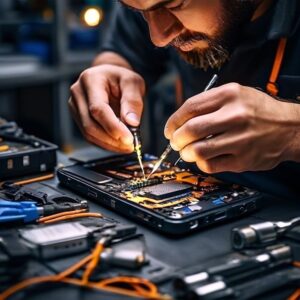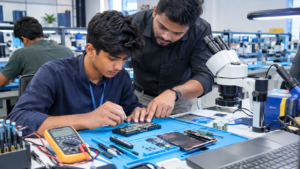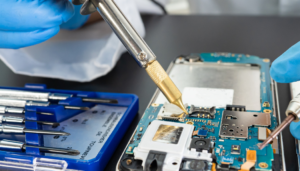
Laptops are an essential part of everyday life, used by students, professionals, businesses, and organisations for work, education, communication, and entertainment. As laptops become more important, skilled technicians are needed to diagnose hardware problems, troubleshoot software issues, and repair damaged components.
For people interested in technology and hands-on work, laptop repairing can offer several career opportunities. With the right training and practical experience, beginners can develop skills in hardware troubleshooting, motherboard repair, chip-level repair, and computer maintenance.
This guide explains the skills required for a career in laptop repair, the available career opportunities, and how beginners can start learning.
What Does a Laptop Repair Technician Do?
A laptop repair technician diagnoses and fixes different hardware and software problems. The job can range from replacing faulty components to diagnosing complex motherboard issues.
Common responsibilities include:
- Diagnosing laptops that do not power on or display properly
- Identifying battery and charging problems
- Testing RAM, SSDs, keyboards, displays, and other components
- Installing operating systems and drivers
- Troubleshooting software-related issues
- Diagnosing motherboard faults
- Performing component-level repairs when properly trained
- Testing laptops after completing repairs
- Explaining repair requirements to customers
A technician may work in a computer service centre, repair shop, electronics business, or independently.
Essential Skills for a Laptop Repairing Career
A successful laptop technician needs both technical knowledge and practical experience.
Laptop Hardware Knowledge
Understanding the main components of a laptop is the foundation of laptop repair. Beginners should learn about processors, RAM, SSDs, motherboards, batteries, cooling systems, keyboards, displays, and charging circuits.
Knowing how these components work together makes it easier to identify potential causes of hardware problems.
Hardware Troubleshooting
Troubleshooting is one of the most important skills for a laptop technician. Instead of simply replacing a component, technicians need to identify the actual cause of a problem.
For example, a laptop that does not turn on could have an issue with the power adapter, charging circuit, battery, power section, or motherboard.
A systematic diagnostic approach can help technicians identify faults more efficiently and avoid unnecessary component replacement.
Chip-Level and Motherboard Repair
Chip-level repair involves diagnosing faults at the component and circuit level of a motherboard. This requires more advanced knowledge than basic component replacement.
Important skills can include:
- Understanding motherboard components
- Reading circuit diagrams and board layouts
- Using a digital multimeter
- Soldering and desoldering
- Understanding power circuits
- Diagnosing motherboard faults
- Using appropriate diagnostic and rework equipment
These skills require proper practical training and experience. Beginners should learn the fundamentals before attempting advanced motherboard repairs.
Software Troubleshooting
Laptop repair is not limited to hardware. Technicians should also understand common software problems.
Useful skills include operating system installation, driver installation, basic system troubleshooting, data backup, and identifying whether a problem is caused by hardware or software.
Being able to distinguish between hardware and software issues can make the diagnostic process more effective.
Communication Skills
Technical knowledge is only one part of working as a laptop technician. Technicians also interact with customers and need to explain problems and repair requirements clearly.
Professional communication, transparent pricing, responsible handling of customer devices, and respect for customer data can help build trust.
Career Opportunities After Laptop Repair Training
Laptop repair training can provide a foundation for several career paths. The opportunities available to an individual will depend on their practical skills, experience, location, and additional qualifications.
Laptop Repair Technician
Laptop repair technicians can work in computer repair shops and service centres. Their responsibilities may include diagnosing faults, replacing components, performing maintenance, and testing repaired devices.
Laptop Hardware Technician
Hardware technicians focus on diagnosing and repairing computer hardware problems. Their work can include component testing, hardware replacement, charging problems, display issues, and motherboard diagnostics.
Advanced hardware roles may require additional knowledge of electronics and chip-level repair.
Computer Service Centre Technician
Computer service centres handle different types of laptop and desktop problems. Working in such an environment can help technicians gain experience with different brands, models, and repair situations.
This can be particularly useful for beginners who want to build practical experience.
Freelance Laptop Repair Technician
Experienced technicians can provide repair services independently. Depending on their skills and business model, they may operate from a workshop or provide services to customers directly.
Freelancing requires more than technical knowledge. Customer management, pricing, equipment investment, scheduling, and data protection are also important.
Laptop Repair Business
Technicians with sufficient experience may start their own laptop repair business.
Services can include:
- Laptop hardware diagnostics
- Component replacement
- Software installation
- Laptop maintenance
- Charging and power-related repairs
- Display and keyboard replacement
- Motherboard repair
Business success depends on factors such as local demand, competition, service quality, operating costs, customer relationships, and technical expertise.
Basic Laptop Repair vs Chip-Level Repair
Basic laptop repair and chip-level repair require different levels of technical knowledge.
| Basic Laptop Repair | Chip-Level Repair |
| Focuses on common hardware and software problems | Focuses on motherboard circuits and electronic components |
| Includes RAM, SSD, keyboard, and display replacement | Includes board-level diagnosis and component repair |
| Requires fundamental hardware knowledge | Requires electronics and advanced diagnostic knowledge |
| Often involves replacing faulty modules | Can involve repairing faults at component level |
Students interested in advanced motherboard repair should build a strong foundation in laptop hardware before moving into chip-level training.
How to Start a Career in Laptop Repairing
Beginners can follow a structured learning path to develop their skills.
1. Learn Laptop Hardware Fundamentals
Start by understanding laptop components, their functions, and common hardware problems. Basic electronics knowledge can also be useful for students interested in motherboard repair.
2. Join a Practical Laptop Repairing Course
A structured laptop repairing course can provide theoretical knowledge as well as practical exposure to diagnostic tools and repair procedures.
When choosing a training institute, consider the syllabus, practical training, equipment, trainer experience, course duration, and the type of repairs covered.
3. Develop Hands-On Skills
Practical experience is essential in laptop repair. Students should practise component identification, testing, troubleshooting, soldering, and other repair techniques under appropriate supervision.
4. Gain Real-World Experience
Working with an experienced technician or service centre can expose beginners to real customer problems and different laptop models.
This experience can help improve diagnostic ability and repair confidence.
5. Keep Learning
Laptop technology continues to change. New processors, storage technologies, motherboard designs, and repair methods are introduced over time.
Technicians should continue learning and updating their technical knowledge to remain effective in the field.
Is Laptop Repairing a Good Career Option?
Laptop repairing can be suitable for people who enjoy technology, electronics, troubleshooting, and practical problem-solving.
The field offers different paths, including employment in repair centres, hardware technician roles, freelance repair services, and starting a repair business.
However, completing a course alone does not guarantee a particular job or income. Practical ability, experience, technical knowledge, customer service, and continuous learning all play an important role in career development.
Before choosing a laptop repairing course, students should compare the syllabus, practical training, equipment, course duration, and admission requirements.
Learn Laptop Repairing at Grandis Technology
Grandis Technology provides training focused on mobile and laptop chip-level repair. Students interested in developing practical repair and motherboard troubleshooting skills can explore the available training programmes.
Before enrolling, review the course syllabus, practical training facilities, duration, and admission information to find a programme that matches your learning and career goals.
Explore the available laptop and chip-level repair training courses at Grandis Technology and contact the institute for current course and admission details.
Frequently Asked Questions
Can I learn laptop repairing after 12th?
Yes. Students who have completed Plus Two can explore laptop repairing courses, depending on the admission requirements of the training institute.
How long does it take to learn laptop repairing?
The duration depends on the course and the level of training. Basic laptop repair and advanced chip-level motherboard repair require different levels of learning and practical experience.
Is laptop repairing different from mobile repairing?
Yes. Although both involve hardware diagnostics and electronics, laptops and mobile phones use different components, circuit designs, and repair methods.
Can I start a laptop repair business after completing a course?
A course can provide the technical foundation, but starting a business also requires practical experience, suitable equipment, customer management, business planning, and knowledge of local demand.
Do laptop repair technicians need chip-level repair skills?
Not every laptop repair role requires chip-level skills. Basic technicians may focus on component replacement and troubleshooting, while advanced motherboard repair requires additional electronics knowledge and practical training.