Is it possible for someone with no previous experience to acquire knowledge about chip level mobile repair? The answer is yes but not through just watching a few repair tutorials on YouTube. Chip-level repair requires electronics knowledge, component testing, precision tools usage, and diagnosing issues on a smartphone’s motherboard.
The best way to go for the beginner is to start slowly. Start with mobile phone hardware and general electronics, learn to operate a multimeter, gain soldering and desoldering skills, and advance to motherboard repairs. With proper training and continuous practice, beginners will be able to get the necessary knowledge in order to start mastering chip-level repair.
This article will walk you through everything you need to know before you start, the skills you will need, tools you will require, step-by-step learning roadmap, practical training and what to consider when enrolling for mobile repair training.
Can Beginners Learn Chip-Level Mobile Repair?
Yes, beginners can learn chip-level mobile repair through structured learning and hands-on practice. However, it is a technical skill that should be developed progressively rather than by immediately working on advanced motherboard faults.
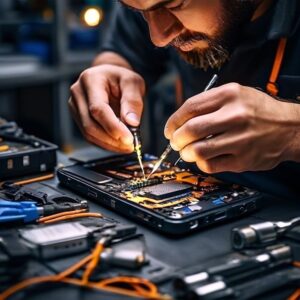
Chip-level repair involves diagnosing and repairing problems at the component or integrated-circuit (IC) level on a smartphone motherboard. A mobile repair technician may need to identify faulty components, perform electrical measurements, trace circuits and carry out precise soldering work.
A beginner does not necessarily need a formal electronics qualification to start. However, developing a good understanding of basic electronics and mobile hardware makes the transition into motherboard-level troubleshooting much easier.
What Should Beginners Learn Before Chip-Level Repair?
Before working on smartphone motherboards, beginners should understand how mobile devices and basic electronic circuits work. These fundamentals provide the foundation for later diagnostic and repair work.
Important areas include:
- Mobile hardware basics: Learn about batteries, charging systems, displays, connectors, cameras, speakers and other major smartphone components.
- Basic electronics: Understand voltage, current and resistance and how they relate to electronic circuits.
- Electronic components: Learn to identify components such as resistors, capacitors, diodes, coils and ICs.
- Circuit fundamentals: Understand how electrical paths work and how components interact within a circuit.
- Electrical measurement: Learn how to take basic voltage, continuity and resistance measurements safely.
A formal electronics background is not necessarily required to begin learning, but basic electronics knowledge becomes increasingly important as the learner moves toward motherboard-level diagnosis.
What Skills Are Needed for Chip-Level Mobile Repair?
Chip-level mobile repair combines technical knowledge with precision-based practical skills. Beginners need to develop both diagnostic ability and safe handling techniques.
Some of the important skills include:
Component identification: Recognising common motherboard components and understanding their basic functions.
Multimeter testing: Using a multimeter to measure voltage, resistance and continuity and identify possible circuit problems.
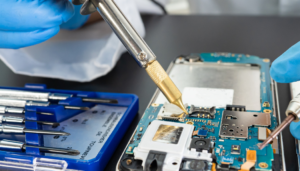
Soldering and desoldering: Removing and installing components without unnecessarily damaging the PCB, or printed circuit board.
Circuit diagnosis: Following electrical paths and using measurements to narrow down possible faults.
Motherboard troubleshooting: Understanding symptoms such as charging problems, power failures and other hardware-related issues and investigating their possible causes.
Schematic understanding: Learning how circuit diagrams and board information can help technicians trace connections and understand component relationships.
These skills develop through repeated practice. Knowing what a component does is different from being able to diagnose a fault on a real motherboard.
What Tools Are Used in Chip-Level Mobile Repair?
The tools used in chip-level mobile repair help technicians inspect, measure, remove and replace components accurately.
Common tools include:
| Tool | Main purpose |
| Multimeter | Measures voltage, resistance, continuity and other electrical values |
| Soldering station | Used for precise soldering and component work |
| Hot air rework station | Helps remove and work with certain surface-mounted components |
| Microscope | Provides magnified visibility for small components and solder joints |
| DC power supply | Helps technicians observe power-related behaviour during diagnosis |
| PCB tools | Used for handling, inspection and motherboard-level repair work |
Beginners should learn how each tool works before using it on valuable customer devices. Incorrect heat, pressure or electrical testing can damage a board, so supervised practice on suitable training boards or devices is useful.
How to Learn Chip-Level Mobile Repair Step by Step
The best learning path is progressive. Beginners should not jump directly into advanced IC or motherboard repair. Start with mobile hardware and basic electronics, learn diagnostic tools, develop soldering skills, and then progress to chip-level troubleshooting.
A practical roadmap looks like this:
| Stage | What to learn |
| 1 | Mobile phone hardware basics |
| 2 | Basic electronics |
| 3 | Components and circuit fundamentals |
| 4 | Multimeter and diagnostic tools |
| 5 | Soldering and desoldering |
| 6 | Motherboard troubleshooting |
| 7 | Schematics and circuit tracing |
| 8 | Chip/component-level repair |
| 9 | Real-device practical troubleshooting |
1. Start with mobile hardware
Understand the main parts of a smartphone and their functions. Learn how different hardware systems interact before moving into motherboard-level work.
2. Build electronics knowledge
Study voltage, current, resistance, continuity and common electronic components. These concepts will help you understand why measurements change when a circuit has a fault.
3. Learn diagnostic tools
Become comfortable with a multimeter and other basic diagnostic equipment. Learn how to take measurements and interpret what they indicate.
4. Develop soldering skills
Practice soldering and desoldering before attempting delicate motherboard repairs. Precision and controlled technique are important because smartphone boards contain small components and closely spaced connections.
5. Move into motherboard diagnosis
Once the fundamentals are established, begin learning how to investigate motherboard faults systematically rather than replacing components without diagnosis.
6. Learn schematics and circuit tracing
Understanding schematics can help technicians follow electrical paths and connect symptoms with specific sections of a circuit.
7. Progress to component and IC-level work
After developing sufficient diagnostic and soldering skills, learners can move toward more advanced component-level and IC-related repair techniques.
8. Practise troubleshooting
Real-device practice helps bring the previous stages together. Learners can develop their ability to identify symptoms, test possible causes and perform appropriate repairs.
For those looking for structured training, Grandis Technology’s smartphone chip-level technology course can be considered alongside the learner’s own research into syllabus, practical sessions and training format.
Is Practical Training Important for Beginners?
Yes. Practical training is particularly important for chip-level mobile repair because many skills cannot be developed fully through theory alone.
Videos and written material can help learners understand concepts, component functions, circuit theory and repair procedures. They are useful for building knowledge before attempting practical work.
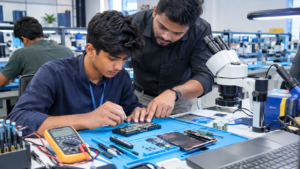
Hands-on training adds another layer. Learners can practise using a multimeter, handling a soldering station, working under a microscope, identifying components and investigating faults on actual boards.
Practical sessions also help beginners understand that real repair work may not always follow a simple step-by-step example. A fault can require multiple measurements and troubleshooting steps before its cause becomes clear.
How Long Does It Take to Learn Chip-Level Mobile Repair?
There is no universal period for learning chip-level mobile repair. The learning curve depends on a person’s previous knowledge, training structure, practical exposure and the amount of time spent practising.
Someone with electronics experience may already understand concepts that a complete beginner needs to learn first. Similarly, a course with regular practical sessions can provide a different learning experience from self-study through occasional videos.
The goal should be progressive skill development rather than trying to complete the learning process within a fixed number of weeks or months.
What Can You Do After Learning Chip-Level Mobile Repair?
Learning chip-level repair can open several potential career paths within mobile-device servicing.
A learner may work toward roles such as:
- Mobile repair technician
- Chip-level repair technician
- Service-centre technician
- Independent or freelance repair technician
- Technician in a mobile repair business
- Repair-business owner after gaining sufficient experience
Career opportunities depend on practical ability, experience, location, employer requirements and the type of repair work a technician can handle. Completing a course alone does not guarantee employment or a particular salary.
For someone considering self-employment, experience with diagnosis, component-level repair and customer-device handling can also become useful when developing a repair service.
How Should Beginners Choose a Chip-Level Mobile Repair Course?
Beginners should compare the actual syllabus and practical training rather than choosing a course based only on its title.
Before enrolling, check whether the course includes:
- Beginner-friendly learning structure
- Basic electronics
- Mobile hardware fundamentals
- Multimeter training
- Soldering and desoldering
- Motherboard troubleshooting
- Schematic reading
- Practical laboratory sessions
- Real-device or suitable board practice
- Experienced trainers
- Clearly explained duration and syllabus
A useful course should show how learners progress from fundamentals toward advanced repair work. It should also provide opportunities to practise rather than relying entirely on demonstrations.
If a course is aimed at beginners, check whether the starting modules explain the basics before introducing complex motherboard or IC-level concepts.
Frequently Asked Questions
Can a complete beginner learn chip-level mobile repair?
Yes. A complete beginner can start learning chip-level mobile repair by first developing knowledge of mobile hardware and basic electronics. The learner can then progress through diagnostic tools, soldering, motherboard troubleshooting and component-level repair. Regular practical training is important for developing the precision and troubleshooting skills required for real repair work.
Do I need an electronics background to learn chip-level mobile repair?
A formal electronics background is not necessarily required to begin. However, understanding basic electronics concepts such as voltage, current, resistance and components is important for progressing into chip-level diagnosis. Beginners can develop these fundamentals as part of a structured mobile repair learning path.
Is chip-level mobile repair difficult to learn?
Chip-level mobile repair involves technical knowledge, precision and systematic troubleshooting, so beginners may find the advanced stages challenging. Starting with fundamentals makes the learning process more manageable. Regular practice with appropriate training equipment can help learners gradually develop their diagnostic and repair skills.
What should I learn first in chip-level mobile repair?
Start with mobile phone hardware and basic electronics. Then learn common components, multimeter testing and basic repair techniques. Once these foundations are established, move into soldering, motherboard troubleshooting, circuit tracing, schematics and eventually component or IC-level repair.
What tools are needed for chip-level mobile repair?
Common tools include a multimeter, soldering station, hot air rework equipment, microscope and DC power supply. Different repairs may require additional equipment. Beginners should first learn the purpose and safe operation of each tool before using it on real smartphones or valuable motherboards.
Can I get a job after learning chip-level mobile repair?
Learning chip-level repair can prepare someone for potential roles in mobile repair shops, service centres, independent repair businesses and freelance work. Employment depends on practical skills, experience, employer requirements and location. A training course should therefore be viewed as skill development rather than a guarantee of a job or salary.
Is practical training necessary for chip-level mobile repair?
Practical training is highly useful because chip-level repair requires hands-on skills. Learners need to practise using diagnostic equipment, soldering tools and microscopes while working with circuit boards. Theory and videos can explain concepts, but repeated practical work helps develop the testing, precision and troubleshooting abilities needed for repair.