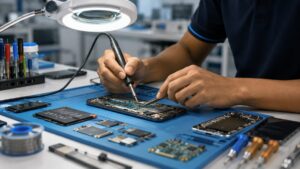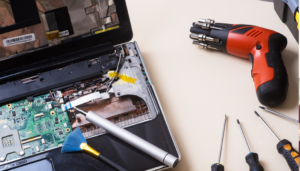
The chip-level mobile repairing Course equips the learner with knowledge on how to diagnose and repair problems at the level of the motherboard, circuit, and electronic components of smartphones. Unlike the replacement of faulty parts such as the display module or the charging port, the learner is equipped with the knowledge of how to diagnose and resolve problems arising from the damage of ICs, tracks, and short circuits.
To an individual who has never repaired phones before, this may sound technical. One way of imagining it would be to imagine a comparison between the mechanic that replaces the faulty parts of the vehicle and the mechanic who knows exactly what wire or component in the vehicle part is causing the problem.
What Does Chip-Level Mobile Repairing Mean?
All smartphones have motherboards with small components like ICs, resistors, capacitors, connectors, and circuits that transmit signals and power. Mobile phone repairs start with the visible and removable parts of the phone, such as the screen, battery, speaker, and charging port.
But chip-level repair goes much deeper than that. The process requires knowledge of how different components work together, testing each component individually, and determining exactly which circuit is faulty. It requires the ability to read circuit diagrams, knowledge of how voltages and currents work, and finding problems that are not visible in visual form, such as a phone that won’t charge even after replacing the charging port, or a phone that turns on without displaying anything on the screen.
In this business, diagnosis always comes before repair. The real problem must be determined first, otherwise making assumptions and randomly replacing components will only cause further damage to the motherboard.
What Do You Learn in a Chip-Level Mobile Repairing Course?
A course like this generally covers:
- Mobile phone hardware fundamentals
- Circuit and motherboard reading
- Component identification
- Using a multimeter and other testing equipment
- Soldering and desoldering techniques
- IC-related troubleshooting
- Charging and power-related faults
- Display and touch-related issues
- Network and signal problems
- Audio and microphone faults
- Short-circuit diagnosis
- Systematic, motherboard-level fault finding
At Grandis Technology, this kind of training is built around hands-on practice with real circuit boards, so students aren’t just learning concepts on paper but actually working through faults the way they would on the job.
Is Chip-Level Repair Different From Basic Mobile Repair?
- Basic mobile repair typically covers screen replacement, battery replacement, charging-port replacement, speaker or microphone replacement, and other module-level swaps.
- Chip-level repair goes further — motherboard diagnosis, component-level troubleshooting, circuit testing, IC-related repairs, short-circuit identification, and more advanced repair techniques.
Who Can Join a Chip-Level Mobile Repairing Course?
Chip-level courses are generally designed for beginners, so prior technical experience isn’t a strict requirement. Students who have completed their 10th or 12th standard, as well as graduates or working professionals looking to switch fields, can typically consider joining. The course also suits people who eventually want to start their own mobile repair business rather than work under an employer.
Exact eligibility criteria can vary by institute, so it’s worth confirming specific admission requirements directly with Grandis Technology before enrolling.
What Practical Skills Can Students Develop?
Because chip-level repair is a hands-on skill, practical training matters more than theory alone. Through consistent practice, students can work on:
- Identifying faulty components on a board
- Handling repair tools correctly
- Testing circuits with a multimeter
- Diagnosing motherboard-level problems
- Performing precise soldering work
- Following a systematic troubleshooting process
- Handling different categories of smartphone faults
Chip-level repair rewards patience and repetition, and the more boards a student works on, the more confidence they gain in their diagnosis.
What Career Opportunities Are Available After the Course?
Depending on the skills developed and local job market, students may explore paths such as mobile repair technician, chip-level repair technician, smartphone service technician, or service-centre technician. Others go on to work independently or open their own mobile repair shop.
Actual results depend on individual skill level, practical experience, location and employer requirements, and no course can guarantee a specific job or income.
Is a Chip-Level Mobile Repairing Course Suitable for Beginners?
Of course, if you have an inclination towards electronics and fixing problems, then this is one area that you can pursue. However, repairing chips is not something that anyone can learn in a day’s time; it requires patience and constant practice. Students who like doing practical and detailed work generally do well here.
How to Choose the Right Chip-Level Mobile Repairing Course?
Before enrolling anywhere, it helps to check:
- How much practical, hands-on training is included
- The depth and relevance of the curriculum
- Trainer experience
- Quality of tools and equipment used
- Whether internship or industry exposure is offered
- Course duration
- Certification provided
- Any career support offered
- Student reviews or testimonials
- The overall training environment
Comparing a few institutes on these points gives a clearer picture than looking at price or duration alone.
Final Thoughts
A chip level phone repair training not only teaches the students how to replace the parts but also gives them the knowledge about electronics used in a smartphone and repair it. This is a practical skill which needs regular practice; however, it provides many opportunities in the form of technician or opening one’s own shop.
If you’re curious about what this kind of training actually involves, it’s worth exploring the course details at Grandis Technology to see how their program is structured.
Frequently Asked Questions
What is a chip-level mobile repairing course?
It’s a training program that teaches diagnosis and repair of smartphone faults at the motherboard and component level, not just part replacement.
Is chip-level mobile repairing difficult to learn?
It has a learning curve, but with consistent practical training, beginners can build the required skills over time.
Can I join a chip-level mobile repairing course after 10th?
Many institutes, including Grandis Technology, welcome students after 10th — it’s best to confirm current eligibility directly with the institute.
What jobs can I get after learning chip-level mobile repairing?
Possible roles include mobile repair technician, chip-level technician, or service-centre technician, among others.
Can I start my own mobile repair business after the course?
Many students use the skills learned to eventually run their own repair shop, though success depends on business skills and experience as well.
How long does it take to learn chip-level mobile repairing?
Course duration varies by institute; check with Grandis Technology for their current course length and schedule.