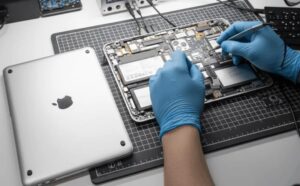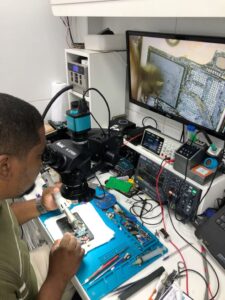
When a phone will not switch on, will not charge or has lost its display after a fall, most shops reach for a replacement part. If the part is not the problem, they often tell the customer the phone is beyond repair. That is where chip level mobile repairing comes in: it fixes the fault on the motherboard itself, so devices that others give up on can be brought back to life.
This guide explains what the skill involves, which faults it solves, the tools you need, how technicians diagnose problems and how to start a career in it.
What is chip level mobile repairing?
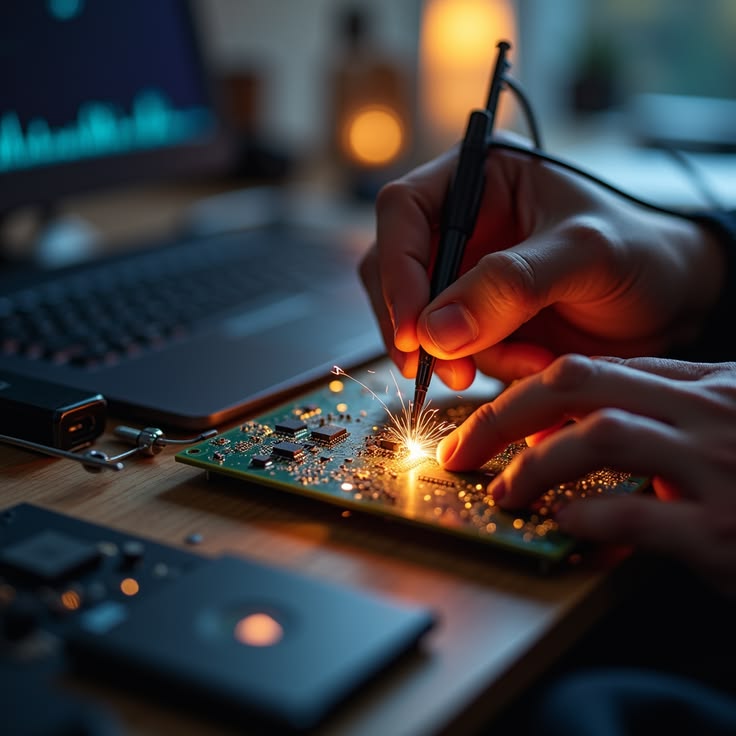
Every smartphone has a motherboard packed with tiny components: power management chips, charging ICs, memory, processors, capacitors and resistors. Chip level mobile repairing means diagnosing which of those components has failed and repairing or replacing it at the board, using soldering, hot air and microscope work.
Basic repair swaps whole modules such as screens, batteries and charging ports. Chip-level repair goes deeper, to the root cause. It takes more training, but it also lets a technician handle repairs that most competitors cannot.
Common faults that need board-level repair
- Phone is completely dead or does not power on
- Charging problems that persist after replacing the port and battery
- No display or backlight issues despite a new screen
- Boot loops and sudden shutdowns
- Overheating and rapid battery drain
- Water damage and corrosion on the motherboard
- Network, audio or sensor faults caused by failed components
Tools used in chip-level repair
- Soldering station and hot air station for removing and fitting components
- Digital microscope for inspecting tiny parts and solder joints
- BGA rework machine for working on chips with hidden solder balls
- Regulated DC power supply to read how much current a dead phone draws
- Digital multimeter for testing continuity, voltage and resistance
- Ultrasonic cleaner for cleaning liquid-damaged boards
- Schematics and board-view software for tracing circuits
How technicians diagnose a dead phone
- Inspect the board for corrosion, bent connectors or visible damage.
- Connect a regulated power supply and observe the current the phone draws.
- Compare the reading with the expected behaviour to narrow down the faulty section.
- Trace the power lines with a multimeter using the schematic or board view.
- Identify the failed component and confirm it with measurements.
- Repair or replace it using hot air, soldering or BGA rework.
- Test the full phone and verify charging, display, network and sound before delivery.
This systematic method replaces guesswork, which is why trained technicians are faster and more reliable.
Skills you need to learn
- Electronics fundamentals and circuit reading
- Clean soldering and micro-soldering technique
- Understanding power flow inside a smartphone
- Using schematics and board-view files
- BGA rework and reballing
- Patience, steady hands and careful documentation
Background reading on how integrated circuits and surface-mount technology work can make the training easier to follow, and the IPC site is useful for understanding soldering and electronics assembly standards.
Chip level mobile repairing training at Grandis Technology
Grandis Technology is the educational division of the Ashtel Group of Companies, established in 2022 in Kerala. Its smartphone chip level technology program offers 8 months of institutional training followed by 12 months of service centre training. Learners who also want laptop skills can choose the smartphone and laptop chip level technology program, which runs 10 months of institutional training plus 12 months of service centre training.
The lab includes BGA machines, CPU reballing systems and precision microscopes. You can meet the trainers on the faculties page, see student outcomes on the placements page and find the nearest location on the branches page. The institute also states that its courses are government-certified under NCVET.
Career options after learning chip-level repair
- Service centre technician for mobile brands and repair chains
- Motherboard repair specialist
- Owner of a mobile or laptop repair shop
- Freelance or on-site repair professional
- Trainer or team lead in a service business
- Technician handling advanced jobs for other repair shops
Mistakes beginners should avoid
- Applying too much heat. Overheating can damage boards and nearby components.
- Replacing parts without testing. Always confirm the fault with measurements first.
- Skipping the microscope. Many faults are invisible to the naked eye.
- Learning only from videos. Real boards and live faults teach what videos cannot.
- Ignoring safety. Use proper ventilation and protect yourself from fumes and hot tools.
Frequently asked questions
What is chip-level repair in simple words?
It is repairing the faulty components on a phone’s motherboard instead of replacing whole parts, so that dead or problem phones can be fixed.
Is chip-level repair harder than basic repair?
Yes, it needs more knowledge of electronics and finer skills, but structured training with real devices makes it learnable.
How long is the training at Grandis Technology?
The smartphone chip level program has 8 months of institutional training plus 12 months of service centre training. The combined smartphone and laptop program has 10 months plus 12 months of service centre training.
Does the institute provide placement support?
It states that it offers placement assistance, career counselling and interview preparation, along with a written job-assurance agreement. See the placements page for details.
Conclusion
Chip level mobile repairing turns a technician from a part changer into a problem solver, and it opens doors to better jobs and a stronger repair business. Choose training with real lab time, proper equipment and service centre experience, and keep practising on live faults. To discuss the program that suits you, contact Grandis Technology or read more about the institute.